





Failure to fuse, also called pseudarthrosis, occurs when a spinal fusion does not heal into a solid bone. This can lead to continued motion at the surgical level and may cause persistent pain or instability.
Quick Facts:
- Occurs when a fusion does not fully heal
- May cause ongoing back or neck pain
- Not all nonunions cause symptoms
- Treatment depends on symptoms and stability
👉 Request an Appointment
👉 Refer a Patient
WHAT IS FAILURE TO FUSE?
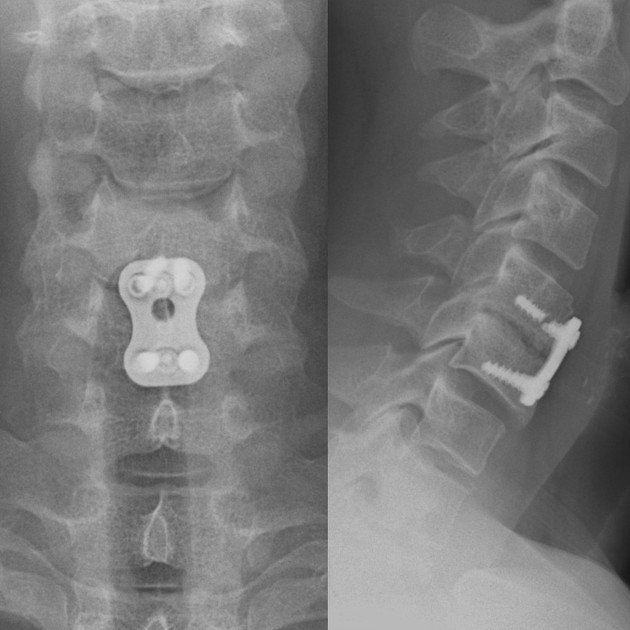
Pseudoarthrosis leading to eventual hardware failure with fracture thought both upper screws
A spinal fusion is designed to permanently connect two or more vertebrae into a single solid bone.
Failure to fuse occurs when:
- The bone does not fully heal across the fused segment
- Motion remains at that level
- The intended stability is not achieved
This is called pseudarthrosis, meaning “false joint.”
👉 The key issue is whether the lack of fusion is causing symptoms
IS THIS SERIOUS?
Failure to fuse varies in clinical significance.
Asymptomatic Nonunion
- No pain or minimal symptoms
- May not require treatment
Symptomatic Nonunion
- Persistent or worsening pain
- Mechanical back or neck pain
- Possible instability
👉 Not all pseudarthrosis requires treatment—only when it is symptom-producing
SYMPTOMS
Common Symptoms
- Persistent pain after fusion surgery
- Pain with movement
- Pain that did not improve as expected
Mechanical Pain Pattern
- Pain with standing, walking, or activity
- Relief with rest
Less Common Symptoms
- Nerve-related symptoms if associated issues are present
🚨 When to Seek Prompt Evaluation
- Persistent or worsening pain after surgery
- New or progressive symptoms
- Functional limitations
👉 These may indicate a structural issue such as nonunion
CAUSES & RISK FACTORS
Failure to fuse can occur for several reasons.
Common Causes
- Incomplete bone healing
- Motion at the fusion site
- Biological or mechanical factors
Risk Factors
- Smoking
- Diabetes
- Osteoporosis
- Multilevel fusion
- Poor bone quality
- Prior surgery
👉 Healing depends on both biologic and mechanical factors
HOW IS THIS DIAGNOSED?
A. Clinical Evaluation
Diagnosis begins with:
- Review of symptoms and surgical history
- Physical examination
- Assessment of pain pattern
B. Imaging
Imaging is essential to assess fusion status.
- X-rays (including flexion/extension views) to assess motion
- CT scan (most important for fusion assessment)
- MRI in select cases
👉 CT is often the best test to evaluate whether fusion has occurred
TREATMENT OPTIONS
A. Non-Surgical Treatment
Not all cases require surgery.
Options may include:
- Physical therapy
- Activity modification
- Pain management
- Injections in select cases
👉 Many patients can be managed without additional surgery
B. When Is Surgery Considered?
Surgery may be considered when:
- There is persistent pain clearly related to nonunion
- There is instability
- Conservative treatment has failed
- Imaging confirms pseudarthrosis
C. Surgical Options
When surgery is needed, it may involve:
- Revision fusion
- Reinforcement with instrumentation
- Bone grafting or biologic augmentation
👉 The goal is to achieve solid fusion and restore stability
OUR APPROACH
At STLMISC, I focus on identifying whether nonunion is truly the source of symptoms.
- Not all pseudarthrosis requires treatment
- Imaging findings must match the patient’s symptoms
- I carefully review prior surgery and imaging
- Surgery is recommended only when there is clear benefit
👉 The goal is to provide clear answers and targeted treatment
WHAT TO EXPECT
Before Treatment
- Review of prior surgery
- Imaging to assess fusion status
- Evaluation of symptom pattern
During Non-Surgical Care
- Focus on symptom management
- Monitoring for changes
If Surgery Is Needed
- Revision procedure tailored to the patient
- Recovery depends on extent of surgery
OUTCOMES & RISKS
Outcomes
- Many patients improve with appropriate treatment
- Revision surgery can be effective when:
- Nonunion is clearly the cause of symptoms
- Stability is restored
Risks of Untreated Symptomatic Nonunion
- Persistent pain
- Instability
- Reduced function
FREQUENTLY ASKED QUESTIONS
Does failure to fuse mean my surgery failed?
Not necessarily. Some patients do well even without complete fusion.
How do I know if my fusion healed?
Imaging, especially CT, helps determine fusion status.
Do I need another surgery?
Only if the nonunion is causing symptoms.
Can this improve without surgery?
In some cases, symptoms can be managed without revision surgery.
FOR REFERRING PHYSICIANS
- Refer patients with:
- Persistent pain after fusion
- Concern for pseudarthrosis
- Imaging suggesting nonunion
- Imaging:
- CT scan for fusion assessment
- Flexion/extension X-rays
- Urgent referral for:
- Significant instability
- Progressive symptoms
RELATED CONDITIONS / PROCEDURES
- Adjacent Segment Disease (ASD)
- Post-Laminectomy Syndrome
- Lumbar Fusion Surgery
- Spinal Deformity
- Lumbar Disc Degeneration
CALL TO ACTION
👉 Request an Appointment
👉 Refer a Patient
📞 Contact STLMISC